
Where Our Cells Come From
The single most important question to ask any clinic
When you are evaluating regenerative therapy, the first question is rarely the one patients ask. People ask about the doctor, the facility, the price. The question that matters most is simpler and harder to answer: where do the cells actually come from, and who made them?
At RegenaMex, the answer is a laboratory called CBCells, a COFEPRIS-licensed, GMP-compliant cell bank whose product has been used in peer-reviewed clinical research. We lead with this because it is the part of the process most clinics cannot speak to with documentation. We can.
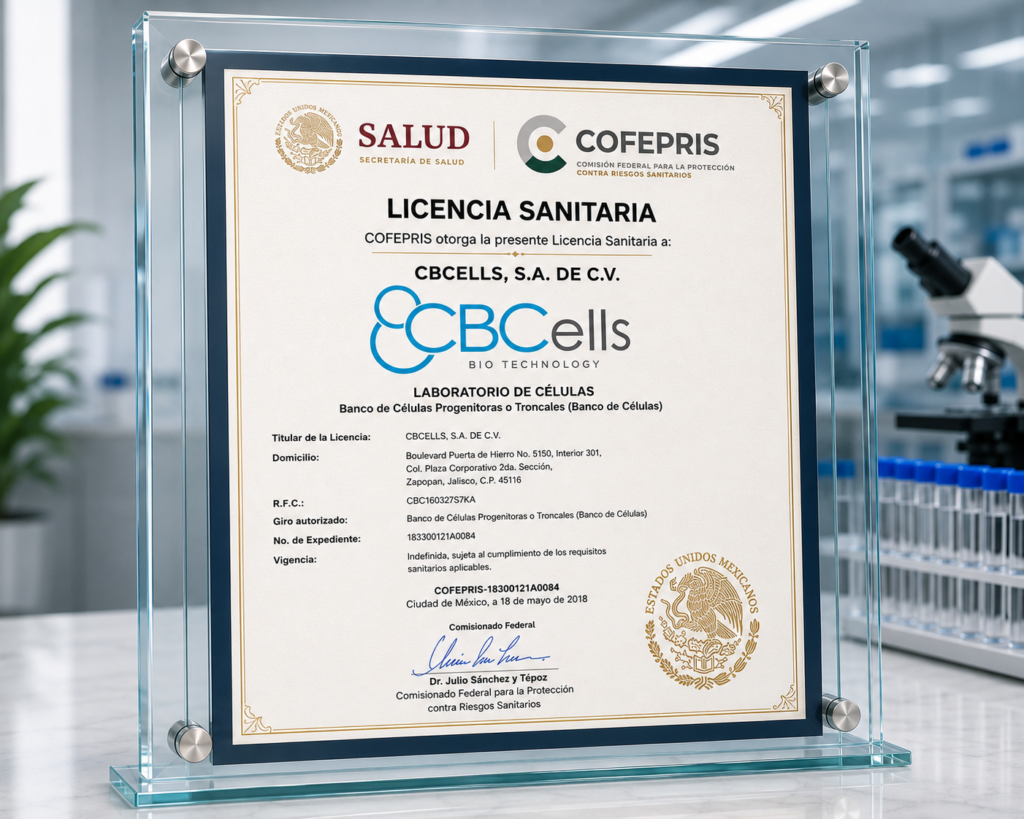
What CBCells is
CBCells is a licensed cell bank operating under COFEPRIS authorization number 18-TR-14-120-0001, registered as a Banco de Celulas Progenitoras o Troncales, a bank of progenitor or stem cells. The authorization was issued in 2018 and is held on an indefinite basis subject to ongoing compliance. This is not a marketing designation. It is a sanitary license issued by Mexico’s federal health authority, the same body that regulates pharmaceuticals and medical establishments across the country.
- COFEPRIS Licensed Cell Bank
- Authorization No. 18-TR-14-120-0001
- Registered Stem Cell Bank
- Licensed Since 2018
- Ongoing Regulatory Compliance
- Federal Health Authority Oversight
What GMP-compliant actually means for you
GMP stands for Good Manufacturing Practice. In plain terms, it is the set of standards that governs how a biological product is processed, tested, documented, and released, so that what reaches the patient is consistent, traceable, and free from contamination. A GMP environment means the cells are not prepared in a back room. They are processed in a controlled facility with defined protocols, quality checks, and a paper trail for every batch.
For you, the practical effect is this: the material used in your therapy is held to the same category of process controls used for products that enter formal research and clinical settings. That is the difference between a cell source you can verify and one you simply have to trust on faith.


Cells used in published research
The strongest signal of a serious cell source is whether independent researchers have used it in work that survives peer review. CBCells cells were used in a clinical study published in the journal Aging and Disease in 2021, conducted alongside two of Mexico’s most respected institutions. We cover that study in detail on our Published Research page, including the affiliated institutions and the DOI so you can read it yourself.
We want to be precise about what that study does and does not establish. It demonstrates that the cells are real, clinical-grade, and credible enough to be used in peer-reviewed research by serious institutions. It is not a claim that this study proves the therapy will resolve any particular condition you may be considering. Anyone who tells you a single study guarantees an outcome is overselling. We would rather you trust us because we do not.
Why we tell you all of this up front
A clinic that is confident in its cell source leads with it. A clinic that is not will redirect you toward testimonials, celebrity names, and atmosphere. We have reputation and word of mouth too, and we are grateful for it, but none of that is a substitute for being able to point at a license number and a published paper. Those are the things that hold up when a sophisticated patient, a physician, or a competitor checks our claims.
What to do next
Read our Published Research page to see the study and the institutions behind it. Review our Regulatory and Safety page to understand the protections COFEPRIS authorization provides. Then talk to us about whether regenerative therapy is appropriate for your situation.

The information on this page is for educational purposes and describes the source, licensing, and processing of the cells used in our therapies. It is not a guarantee of any specific medical outcome. Regenerative therapies are not a substitute for conventional medical care. Speak with a qualified physician about whether any treatment is appropriate for your individual situation.