
There comes a moment for anyone with chronic knee pain when the question stops being “What can I do?” and becomes “Which path will actually work?” For decades, the answer was almost similar: surgery. A total knee replacement, or perhaps an arthroscopic cleanup, followed by months of rehab, ice packs, and the quiet hope that the artificial joint would feel natural. But a different approach has been gaining ground, one that doesn’t remove tissue, but instead helps the body rebuild it.
Stem cell therapy for knees has moved from the fringe of regenerative medicine into the spotlight. And for anyone weighing their options, the comparison is no longer hypothetical. It’s about recovery time, risk, long-term outcomes, and the simple question of whether metal and plastic belong in a knee that might still be capable of healing itself.
Two Philosophies, One Goal
Surgery and stem cell therapy are not just different procedures; they represent fundamentally different ways of thinking about injury and degeneration.
Knee replacement surgery is a form of controlled demolition. The surgeon removes damaged bone and cartilage, then installs an implant made of cobalt-chromium or titanium, with a polyethylene spacer to mimic joint movement. It works especially for end-stage where the joint has collapsed. But it also permanently alters the knee. Recovery is observed in months, activity restrictions are common, and the implant has a finite lifespan.
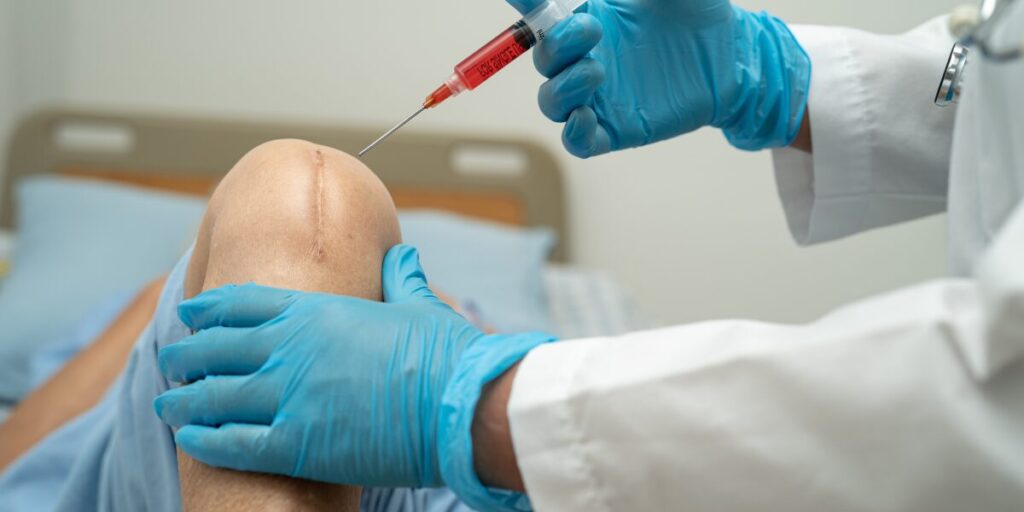
Stem cell therapy, by contrast, works with the body’s own repair mechanisms. Concentrated mesenchymal stem cells, harvested either from the patient’s own bone marrow or adipose tissue, or derived from ethically sourced perinatal tissues and are injected directly into the damaged joint. Their work is not to change the knee, but to decrease inflammation, enhance the immune response, and stimulate regeneration of cartilage, tendons, and ligaments.
At Regenamex, this biological approach is the foundation of care. The aim is to enable the patient to avoid the scalpel as much as possible, yet deliver effective pain relief and functional correction.
Why Stem Cell Therapy Is Different
Stem cell therapy does not come with a lifetime guarantee, but it offers advantages that surgery cannot match.
- It works with biology, not against it.
When stem cells are injected into an arthritic or injured knee, they do more than just fill a gap. They release growth factors that suppress inflammation, often the primary driver of pain. They can differentiate into cartilage cells, helping to rebuild worn cushioning. And they strengthen surrounding soft tissues, which improves joint stability. - Recovery is measured in days, not months.
Most patients resume light activities within a few days. There is no prolonged immobilization, no risk of muscle atrophy from being bedridden, and no weeks of heavy narcotic use. - There is no foreign material.
Whether the cells are autologous or derived from perinatal sources, there is no risk of rejection. The body recognizes the cells as its own, and the only “implant” is the patient’s own regenerated tissue.
The Shift Toward Regenerative Options
One of the most common questions patients ask today revolves around access: Where can I get this treatment without paying a fortune?
That search often leads south. Stem cell injections for knees in Mexico have become a major topic of discussion, and for good reason. In the United States, FDA regulations restrict many of the more potent forms of stem cell therapy particularly those involving culture-expanded cells or certain perinatal products. As a result, patients often face a choice between a limited regenerative option domestically or traveling to a country where advanced protocols are legally available.
Stem cell therapy Tijuana Mexico has emerged as a hub for this reason. Clinics like Regenamex work under strict safety standards and also provide treatment that often exceeds what is possible north of the border. The result is a combination of higher cell potency, precision-guided injections, and a level of expertise that comes from performing these procedures daily.
How Stem cell injections for knees Mexico work?
When someone searches for stem cell injections for knees Mexico, they are usually looking for three things: credibility, safety, and value.
In Tijuana, the medical tourism infrastructure is mature. Facilities are modern, many physicians are bilingual and US-trained, and the standard of care often mirrors or exceeds what patients expect in the United States. The difference is that the regulatory environment allows for the use of advanced biologics that can dramatically improve outcomes.
The procedure itself is minimally invasive. There are no large incisions, no hospital stays, and no months of opioid dependence. Patients typically walk into a clinic, receive the injection under ultrasound or fluoroscopic guidance (which ensures the cells go exactly where they are needed), and walk out within a few hours.
Why to take Affordable stem cell therapy in Mexico?
Cost remains one of the most significant barriers to regenerative care. In the United States, a single stem cell injection can range from $5,000 to $15,000. A knee replacement, depending on insurance coverage, can cost anywhere from $35,000 to $70,000 and that is before factoring in deductibles, copays, and lost wages during recovery.
This is why the search for affordable stem cell therapy in Mexico has grown so rapidly. At Regenamex, the pricing structure is transparent and significantly lower than US alternatives. Several factors drive this:
- Stem cell therapy Tijuana Mexico has lower operational costs and allows for competitive pricing without compromising quality.
- Direct cash pricing eliminates the inflated billing structures common in US hospital systems.
- High procedural volume means the clinical team has refined its protocols to maximize efficiency and safety.
For patients who travel to Regenamex, the total investment including travel, lodging, and the procedure itself often ends up being 50 to 70 percent less than the cost of surgery in the United States. And that is before considering the intangible costs of lost work time, physical pain, and rehabilitation.
How Regenamex Stands out best of all others?
For anyone considering stem cell injections for knees in Mexico, the quality of the provider matters as much as the treatment itself.
Regenamex operates with a structured process designed to ensure that only appropriate candidates receive treatment. It begins with a remote review of the patient’s MRI and medical history. Not everyone is a good candidate, advanced bone-on-bone arthritis may still be better served by surgery but for those who qualify, the process is precise.
On the day of treatment:
- Cells are harvested (if autologous) or prepared from high-quality perinatal sources.
- The material is processed in a laboratory that adheres to strict sterility and potency standards.
- The injection is performed under real-time imaging guidance to ensure accurate placement.
Many patients receive a combination of stem cells, platelet-rich plasma (PRP), or exosomes to amplify the regenerative environment.
Tips for Making the Decision?
Choosing between surgery and stem cell therapy is rarely a simple matter of “which is better.” It is a decision shaped by the severity of the condition, the patient’s age and activity level, and the willingness to undergo an invasive procedure.
For those with mild to moderate arthritis, ligament injuries, or cartilage defects, stem cell therapy for knees offers a compelling alternative. It provides the possibility of healing without the permanent alteration that surgery imposes. For those with end-stage joint collapse, surgery may remain the only viable option.
The encouraging reality is that the choice no longer has to be made from a place of limited options. Advances in regenerative medicine and the accessibility of high-quality care at Regenamex in Tijuana Mexico mean that patients can explore a biological solution before committing to the scalpel.
Knee pain does not have to dictate the terms of life. Sometimes the most effective treatment is the one that works with the body, not against it.